


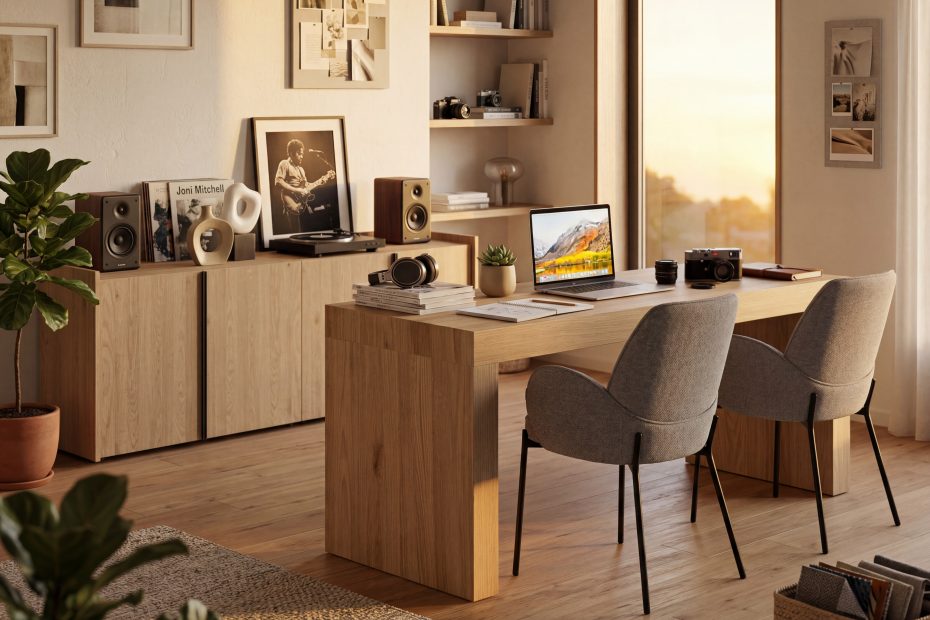
Some people have an entire room available, some make do with a corner in the hallway, and some have turned the living room armchair into a workstation without anyone noticing. Whatever your starting point, setting up a home office takes a little planning and a few smart choices.
This space, whether small or large, needs to help us focus and, ideally, not make us want to get up every ten minutes. The secret? It is not about buying the most expensive desk in the catalog, but about really understanding how we work or study every day, and building the room around that need.
Essential furniture for a functional home office
The office desk: how to choose the right one
The office desk is the piece of furniture where it is not worth cutting corners on quality, and especially not on size. A surface that is too small quickly becomes the source of increasingly tense relations between mug, notebook, keyboard, and charger.
A desk at least 20-24 in deep allows you to keep the monitor at the correct distance from your eyes; the width depends on how you use it, from about 35 in for a single screen up to about 63 in for more elaborate workstations.
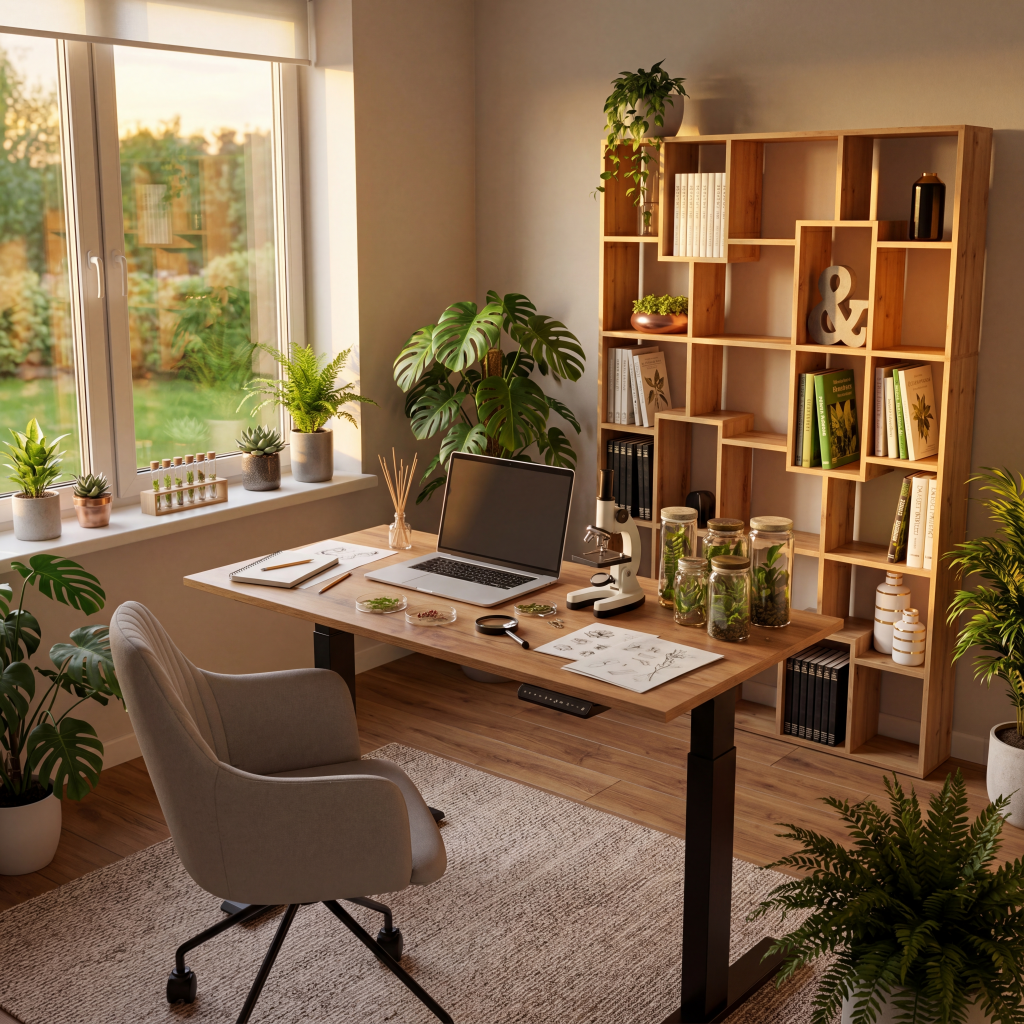
A detail often underestimated: the space under the desk. The height of the desk should be sufficient to allow a comfortable leg position, without restrictions. In this sense, adjustable desks are a valuable ally: they offer maximum versatility and adaptability, especially if they are used alternately by more than one person.
The right chair for the home office
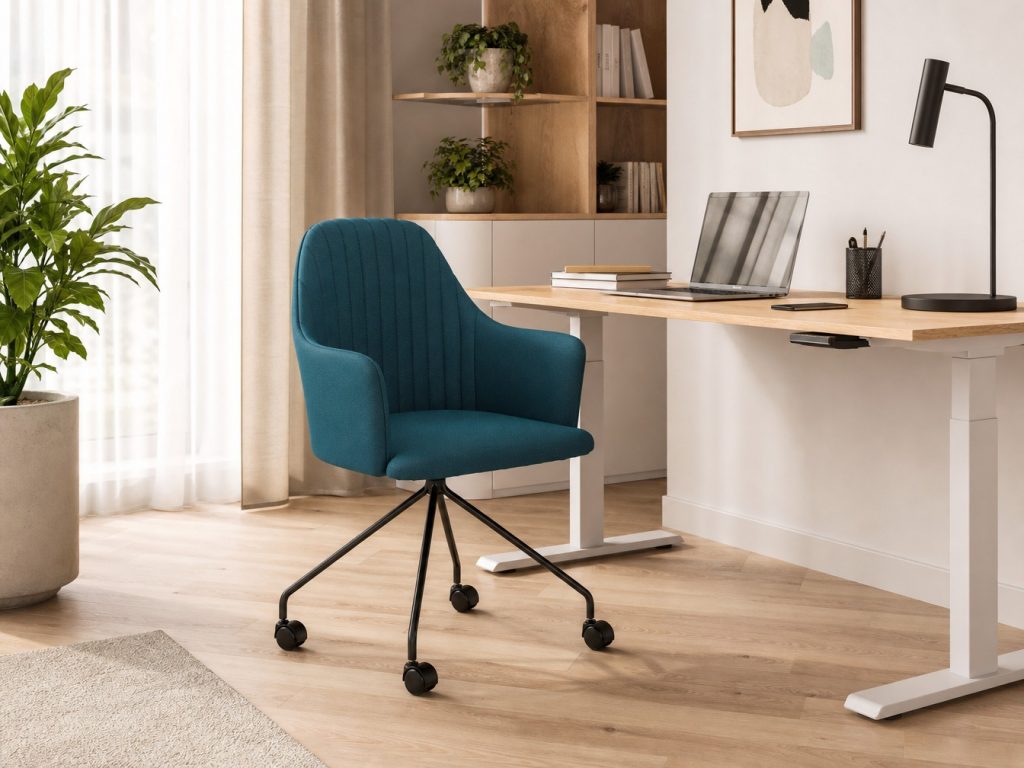
The right chair for a home office is not necessarily the office chair with a thousand adjustments and the look of a spaceship cockpit. For those who work or study a few hours a day, a chair with a high back, padded seat, and correct proportions in relation to the desk already does an excellent job. The important thing is that feet rest flat on the floor and knees remain at around ninety degrees. For this reason, it is essential to choose the home office chair according to the height of the work surface.
Office chairs with a refined design integrate better into a home office, especially when the space is part of a larger room such as the living room or bedroom. In these settings, a model that also holds its own aesthetically is a smarter choice than a purely technical model that clashes with the rest of the furniture.
Bookcases, drawer units, and office cabinets
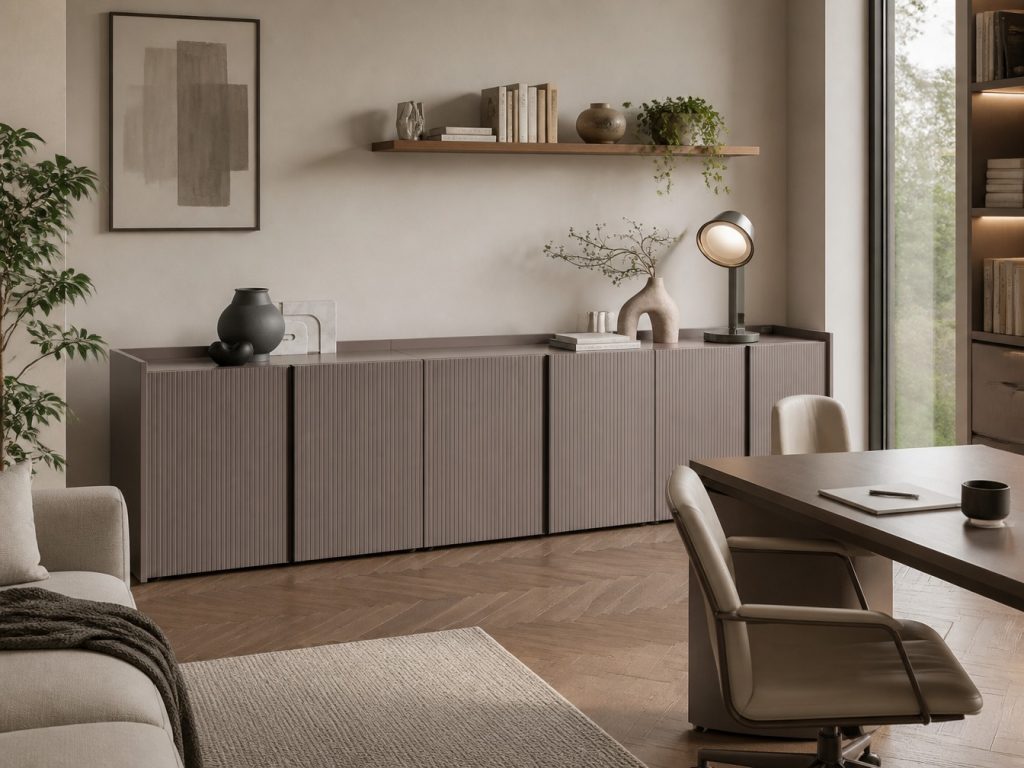
Organization is the real challenge of the home office because clutter has the terrible habit of spreading as soon as we get distracted for a moment. Office bookcases are invaluable allies: they make use of the vertical space on the walls, freeing the work surface from books, binders, and reference materials. The choice between open and closed bookcases depends on your relationship with visual clutter: if we need a visually clean environment, it is better to choose a structure with doors or drawers; if instead we want everything within reach and on display, we can opt for open structures.
For managing documents, stationery, and small objects, drawer units are versatile solutions that can be positioned under the desk or beside it, without taking up valuable space. Office cabinets complete the workstation with additional storage for anyone with many materials to organize or simply a special talent for accumulating things “that might come in handy”.
Desk accessories: the details that make the difference
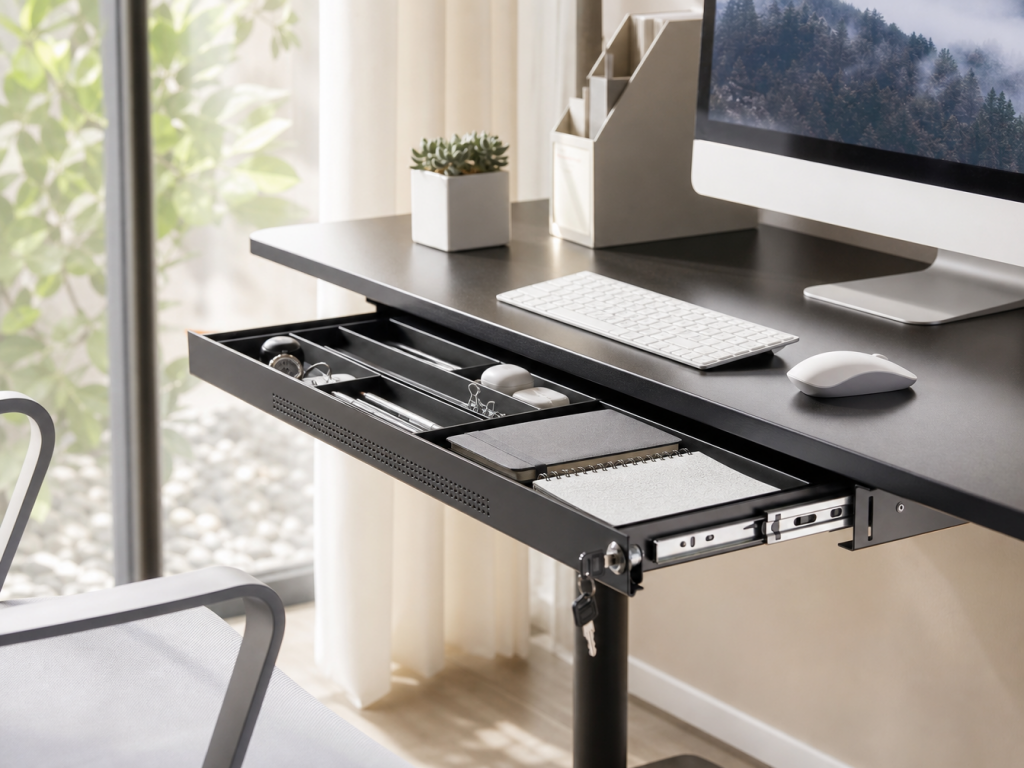
Pen organizers, document trays, cable management, monitor stands: small desk accessories are often the difference between a workstation that really works and one that always looks messy, even when we swear we tidied it up five minutes ago.
How to set up a home office nook in the living room or bedroom
Those who work or study in a corner of the living room or bedroom need to think vertically. A compact desk paired with a discreet bookcase, with high shelves and a few well-organized containers, can be enough for a complete workstation without giving the impression that work has officially colonized the home.
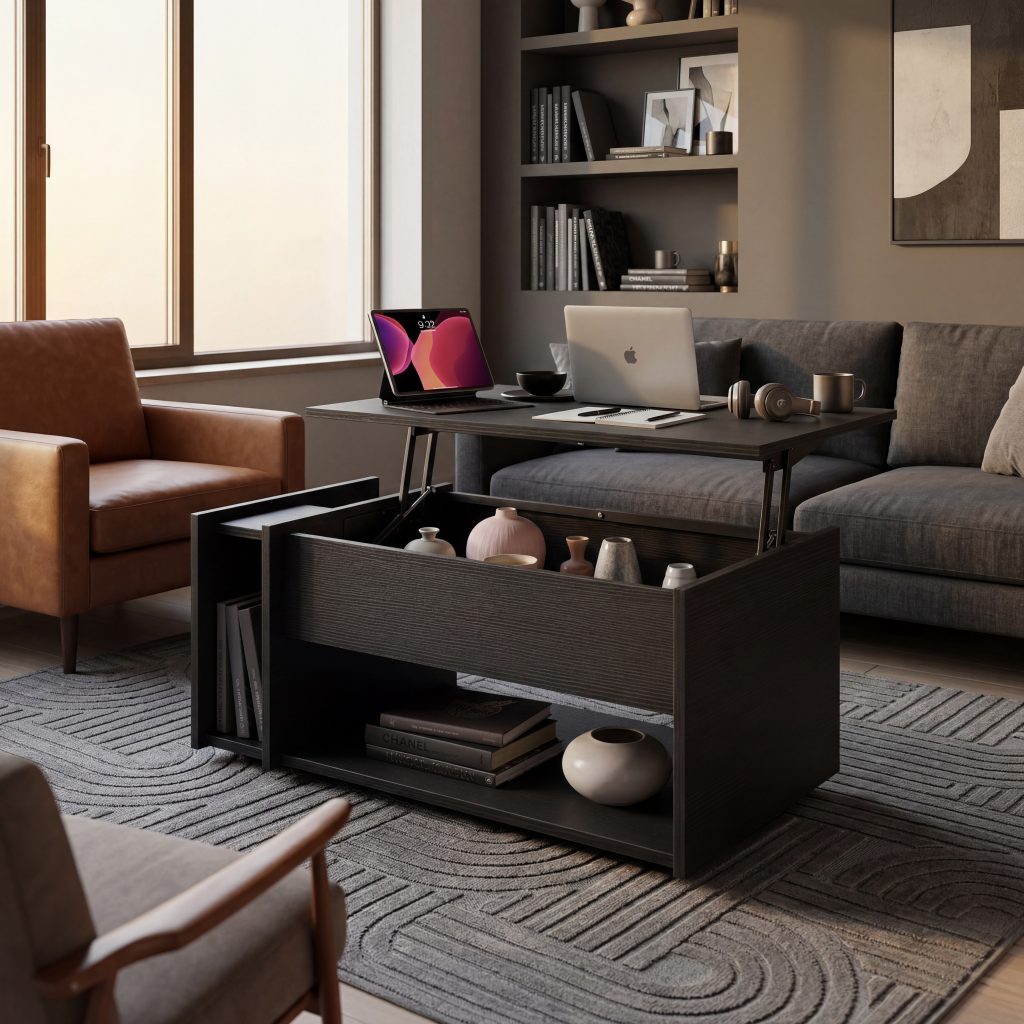
For those who want a home office nook that “disappears” at the end of the day, the most effective solutions are wall-mounted folding desks, bookcases with integrated work surfaces, and storage units with doors that hide the workstation when it is not in use. The advantage, beyond aesthetics, is psychological: visually separating work time from rest time helps you truly switch off.
Which colors to use in home office decor
The most suitable colors for a home office are neutral shades such as white, light gray, beige, and sage green, because they support concentration. A touch of color, perhaps on just one wall or in the accessories, can add character without becoming distracting, which is more or less what we also ask of anyone who comes in while we are working.
It is better to avoid very saturated colors on large surfaces: red, bright orange, and intense yellow increase visual stimulation and, over time, can become tiring. We certainly do not need a highlighter-colored wall to make us feel even more under pressure.
How to light the home office
No artificial lighting can replace natural light, but a good desk lamp is essential. The light should be directed onto the work surface, with a cool white or neutral white color temperature (between 4000 and 5000 K) to support concentration. In the evening, or when there is less light, it is useful to add diffused ambient lighting that reduces the contrast between the screen and the rest of the room.
The computer screen, moreover, should never be the only source of light in the room. Always keeping a background light on, and perhaps a desk lamp too, protects our eyes and avoids the “nocturnal creature in front of the monitor” effect.
Plants to choose for the home office
One or two indoor plants, perhaps with vertical growth, make the home office more pleasant to live in every day. Particularly striking options include the Bird of Paradise, the Rubber Plant, and Howea Forsteriana. The latter, in particular, also adapts well to poorly lit spaces. Other indoor plants especially suited to less bright areas are pothos, sansevieria, and zamioculcas, also suitable for those whose relationship with gardening is made up of good intentions and questionable results.
Rugs and decorations to complete the space
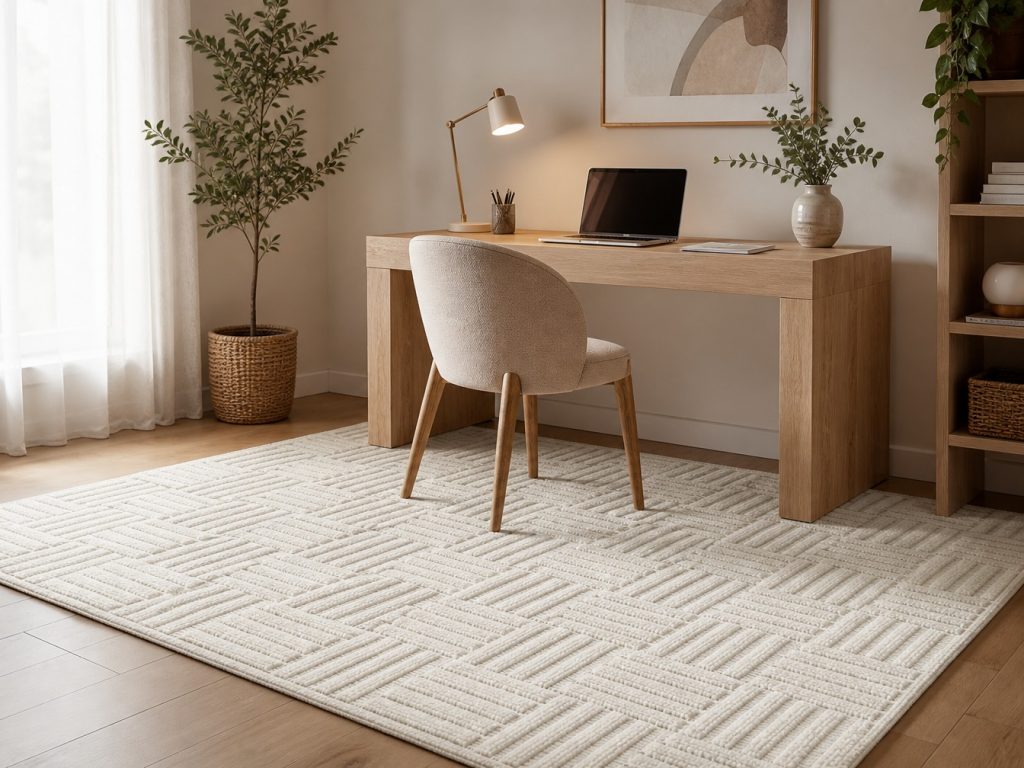
A rug under the desk, soft curtains at the windows, or even an acoustic wall panel reduce reverberation and make the space feel more intimate and comfortable.
Decorations follow a simple rule: less is more, but that little has to make sense. An object that tells a story, a print, a plant: these are what truly turn a functional home office into a space where you actually want to stay.